
From “Trust but Verify” to
“Verify Before Trust”
Why FaceOff Is Redefining Digital Truth & The Zero-Trust Security Model
In 2025, synthetic media crossed a decisive threshold into everyday operational reality. As we step into 2026, implicit trust in digital communication no longer exists — if something cannot be verified instantly, it cannot be trusted at all.
The old cybersecurity mantra, “trust but verify,” has inverted completely. Today, if something cannot be verified instantly, it cannot be trusted at all—whether it comes from a colleague, a leader, a public figure, or even a loved one.
This is not paranoia. It is adaptation.
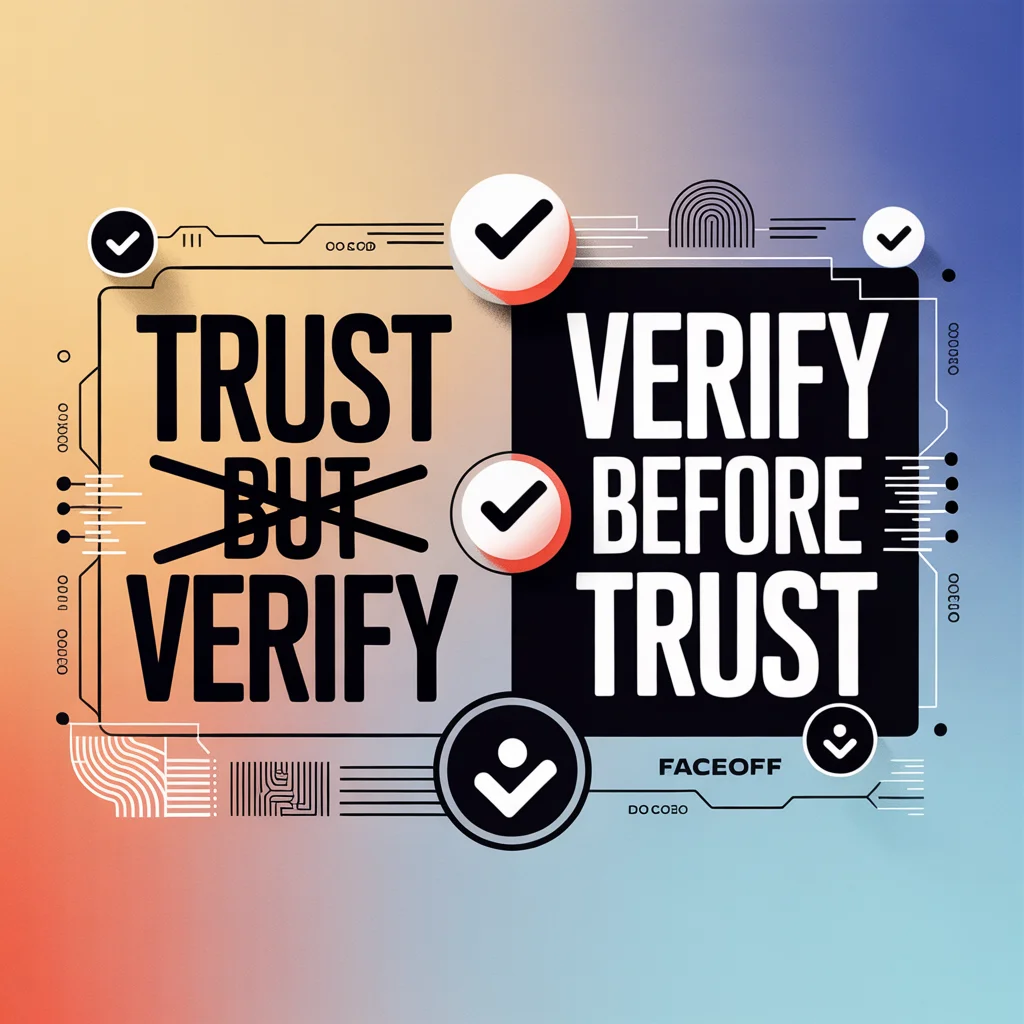
Traditional perimeter trust is mathematically insolvent against generative AI. We replace delayed checks with continuous multi-signal verification.
Ground-Truth Forensic Detection
At FaceOff, we did not arrive at this conclusion theoretically. We arrived at it through real-world detection, forensic analysis, and live deployments—where deepfakes are no longer obvious, delayed, or poorly executed, but realistic, convincing, and deployed precisely where damage is maximal.
FACEOFF LIVE FORENSIC TELEMETRY ENGINE
142.6 Hz (Human)
0.001% (Clean)
VERIFICATION: CONFIRMED REAL
Deepfakes Are No Longer a Content Problem. They Are a Trust Problem.
The last year made something painfully clear: deepfakes are not about viral videos anymore. They are about breaking human trust at scale.
Voice cloned in 3 seconds from public audio snippets.
Real-time face swaps during live executive video calls.
Synthetically merged government documents & tax records.
Forged board approvals and emergency capital transfers.
What Changed in 2025
The three major attack vectors that rendered classical verification methods obsolete.
Executive & Government Impersonation
Real-time voice cloning was used to impersonate senior executives and government officials, bypassing established verification processes.
Synthetic Job Candidates
Job candidates successfully interviewed and were hired using synthetic video overlays, forcing organizations to revert to in-person verification.
Synthetic Identity Fraud
Financial onboarding and identity verification systems were compromised by synthetic identities, contributing to billions in losses globally.
The question will no longer be:
“Is this content fake?”
“Can this interaction be proven real?”
FaceOff was built for this exact moment.
Why the Deepfake Problem Will Accelerate, Not Plateau
CHEAPER
Commoditized open-source voice & video weights
FASTER
Sub-second generative rendering on standard hardware
MORE ACCESSIBLE
Zero coding required; prompt-driven execution
MORE SCALABLE THROUGH AI AGENTS
Autonomous bots running mass social campaigns
Asymmetric Attack Velocity
“We now live in a world where a single malicious actor can launch one-to-many deception campaigns with minimal effort—across video, voice, and identity—while remaining anonymous.”
ONE ACTOR → MANY SYNTHETIC IDENTITIES → MANY TARGETS
How automated AI agents scale deception attacks simultaneously across multiple institutional vectors.
FaceOff Does Not Treat Deepfakes as Isolated Media Artifacts
We Treat Them as Coordinated Deception Events.
Beyond the Deepfake Artifact
Continuous telemetry correlation across temporal, cross-modal, and behavioral dimensions.
Detect Impersonation Patterns Across Time
Tracks persistent anomaly trajectories across multiple interaction sessions.
Correlate Identity Drift Across Media
Maps synchronization discrepancies across video feeds, voice cadences, and metadata.
Identify Behavioral Inconsistencies
Flags cognitive and physiological micro-signals that generative AI cannot replicate.
Deepfakes Will Become Indistinguishable to Humans—
But Not to FaceOff.
Deepfakes are designed to fool humans, not machines. The leap in realism from successive generations of generative models has already surpassed human perceptual limits. Even trained professionals can no longer reliably distinguish real from fake using visual or auditory cues alone.
FaceOff Does Not Rely on Superficial Artifacts
Our models verify biological and temporal coherence that persists even as generative quality improves.
Micro-behavioral patterns
Subconscious pupil response, saccadic eye movements, and micro-expressions.
Temporal biometric consistency
Frame-to-frame physiological blood-volume pulse continuity (rPPG).
Expression-to-speech alignment
Phonetic-to-viseme acoustic synchronicity across complex utterances.
Physiological and motion coherence
Neck arterial pulsation and skeletal kinetic physics over duration.
These are signals that persist even as realism improves—and signals that FaceOff continuously refines through live exposure to emerging threats.
As generative models evolve, FaceOff evolves ahead of them, not reactively.
Why FaceOff’s Detection Is Fundamentally Stronger
Deepfake detection is not a single model problem. It is an ecosystem problem.
Multi-Model Ensemble Intelligence
Uses multi-model ensemble intelligence, not a single brittle classifier.
Behavioral Truth
Focuses on behavioral truth, not pixel perfection.
Explainable Trust Scores
Generates explainable trust scores, not opaque binary labels.
Multimodal Context
Operates seamlessly across video, voice, identity, and interaction context.
“Does this look fake?”
Relies on surface pixel heuristics, blurring artifacts, and single-image classifiers that fail when generation resolution scales.
“Does this behave like a real human across time, context, and intent?”
Fuses multimodal streams: VIDEO + VOICE + BEHAVIOR + IDENTITY + CONTEXT + TIME + INTENT.
Verification Is the New Perimeter
By 2026, resilience—not reaction—will define who survives the deepfake era.
What Resilient Organizations Will Do
Embed verification into every high-risk interaction
From wire authorizations to credential issuance, every session is continuously asserted.
Treat digital trust as infrastructure, not policy
Digital trust is integrated natively into core API rails and identity pipelines.
Deploy real-time detection, not post-incident analysis
Stop deceptive attacks in flight before transactions complete or data leaves enclaves.
FaceOff is already powering this shift—helping enterprises, governments, and platforms move from damage control to deception prevention.
This Is Not a Forever Problem—
but 2026 Is a Defining Year.
Deepfakes are not an unsolvable challenge. But they demand better systems, not incremental fixes.
Sovereign Ecosystem Collaboration
FaceOff does not claim to solve this alone. Collaboration across platforms, regulators, and technology providers is essential. But FaceOff is uniquely positioned to lead because we built our platform for where the threat is going—not where it has been.
The coming year will be a period of necessary growing pains. A recalibration of how truth, identity, and trust are established in digital spaces.
When We Eventually Restore Confidence in What People See, Hear, and Experience Online, It Will Not Be Because Deepfakes Disappeared—
But Because Verification Became Universal.