Lithium Demand May Top 13 Million Tonnes by 2050
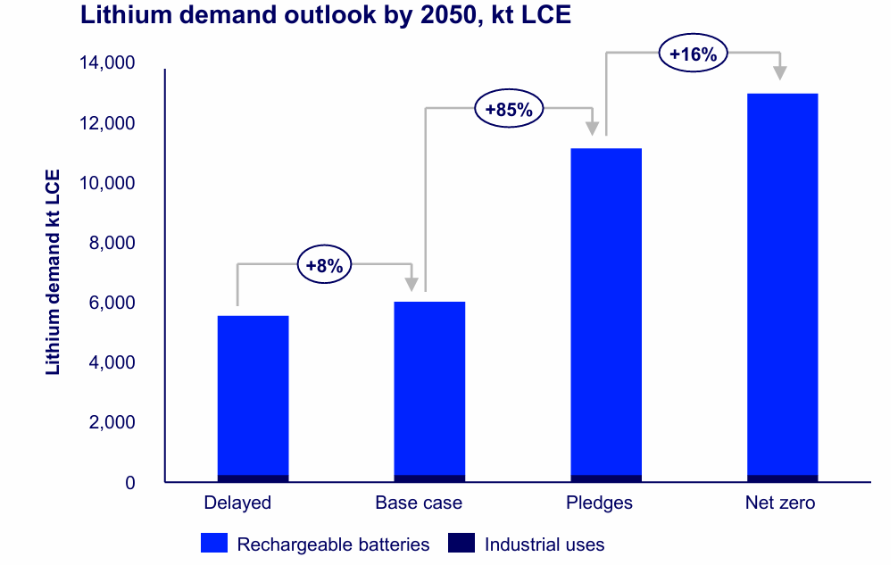
LONDON/HOUSTON/SINGAPORE – Global lithium demand could exceed 13 million tonnes by 2050 under an accelerated energy transition, more than double base case projections, according to Wood Mackenzie’s latest Energy Transition Outlook for Lithium. Without significant new investment, supply deficits could emerge as early as 2028. Even under the Wood Mackenzie’s base case scenario, existing supply projects are unlikely to meet demand beyond the mid-2030s, highlighting the need for sustained investment across the value chain.
“The lithium market is heading into a supply crunch much sooner than many industry players expect,” said Allan Pedersen, Research Director at Wood Mackenzie. “Under ambitious climate scenarios, we see deficits emerging from 2028. The industry needs to act now should governments
Note: Base case figures are based on the Global lithium investment Horizon Outlook Q3 2025
Demand growth driven by electrification
Wood Mackenzie models four energy transition pathways, with lithium demand in 2050 ranging from 5.6 Mt LCE under a delayed transition to 13.2 Mt LCE in a net zero scenario.
· Under the Delayed Transition scenario, the market remains adequately supplied until 2037 before entering deficit.
· Under the Country Pledges scenario, deficits emerge around 2029, requiring an additional 6.7 Mt LCE of supply by 2050 to meet projected demand.
· Under the Net Zero scenario, deficits are expected to begin in 2028 and persist through mid-century. Additional supply of approximately 8.5 Mt LCE will be required by 2050.
Electric vehicles (EVs) remain the primary driver of demand growth, accounting for 72–80% of lithium consumption across scenarios. EV penetration reaches approximately 75% by 2040 under the Country Pledges scenario and 95% under the Net Zero scenario.
The report also noted that rechargeable batteries across all applications account for 96–98% of lithium consumption by mid-century.
“EVs remain the primary driver of lithium demand growth, but energy storage systems (ESS) are the sleeper story” said Rebecca Grant, Senior Research Analyst at Wood Mackenzie. “ESS demand grows at 6-7% annually in our forward scenarios as renewables dominate new power capacity and grids require flexibility at scale.”
Rapid demand growth will require substantial new supply
Under the Country Pledges scenario, the supply gap reaches 6.7 Mt LCE by 2050. Under the Net Zero scenario, the gap widens to 8.5 Mt LCE. Recycling will contribute increasing volumes of supply but is unlikely to address near-term shortages. Recycled supply grows at 13–16% annually, with meaningful volumes emerging from the 2040s as electric vehicle batteries reach end-of-life.
By 2050, recycling contributes between 2.3 Mt and 2.7 Mt LCE under ambitious scenarios, noted Wood Mackenzie.
Meeting demand requires unprecedented investment
According to Wood Mackenzie, total investment requirements range from approximately $104 billion under a delayed transition scenario to $276 billion under a net zero scenario.
Investment requirements under different scenarios:
· Delayed Transition: $104 billion
· Base Case: $114 billion
· Country Pledges: $236 billion
· Net Zero: $276 billion
Investment is expected to peak between 2030 and 2034, driven by the need for new mining capacity, refining infrastructure and regional supply chains.
"This is a $100-275 billion investment story depending on how the energy transition unfolds,” Grant said. “The winners will be those who can deploy capital efficiently while navigating trade fragmentation and securing regional market access.”
About Wood Mackenzie: Wood Mackenzie is the global insight business for renewables, energy and natural resources. Driven by data. Powered by people. In the middle of an energy revolution, businesses and governments need reliable and actionable insight to lead the transition to a sustainable future. That’s why we cover the entire supply chain with unparalleled breadth and depth, backed by over 50 years’ experience in natural resources. Today, our team of over 2,000 experts operate across 30 global locations, inspiring customers’ decisions through real-time analytics, consultancy, events and thought leadership. Together, we deliver the insight they need to separate risk from opportunity and make bold decisions when it matters most. For more information, visit woodmac.com.