
Turn Your AI Security Spectacles into Thinking Security Systems: A FaceOff Approach Implementation
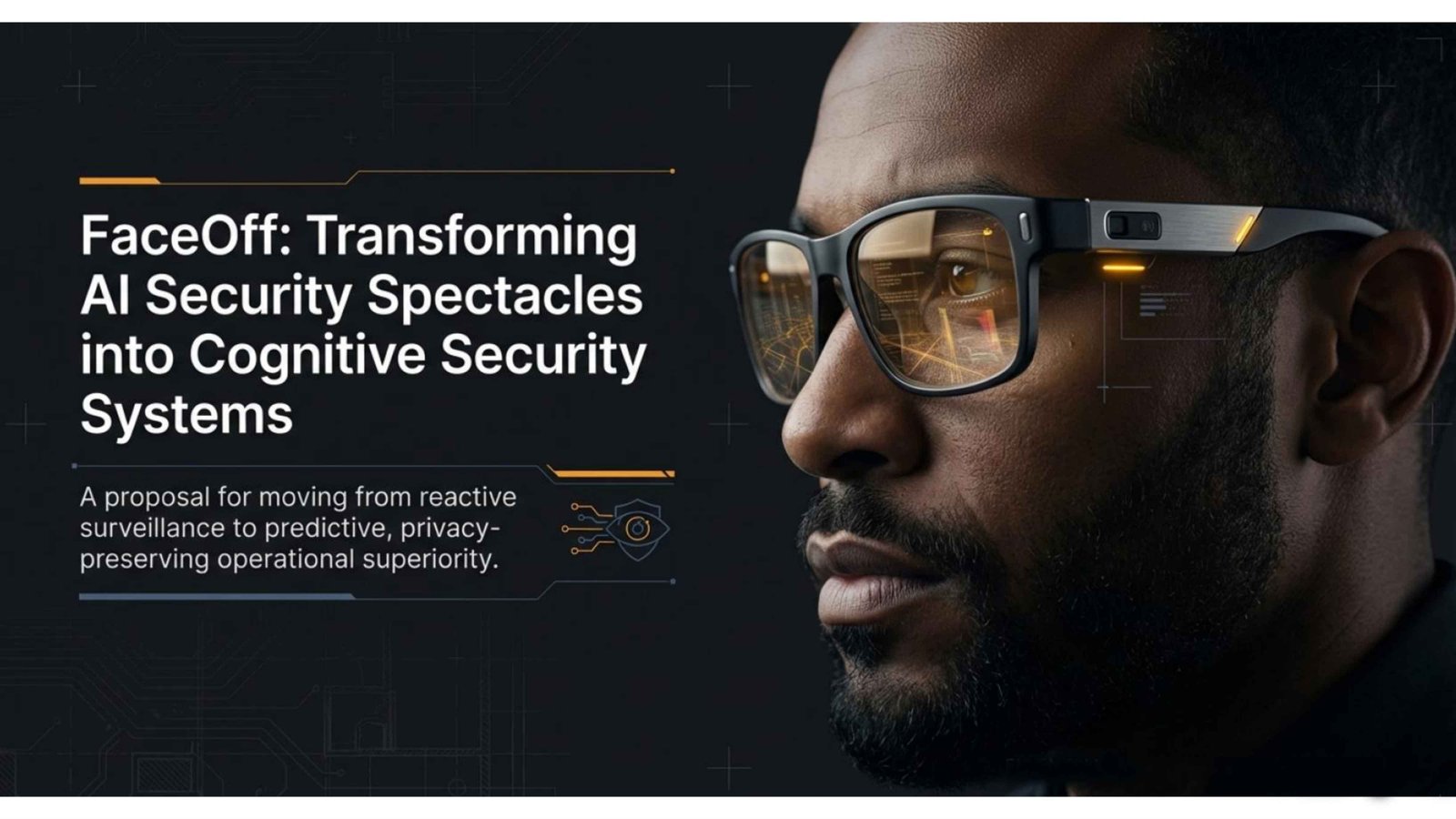
Today, mega public gatherings and critical infrastructure installations along with urban safety operations are confronted by a plethora of threats including identity impersonation, falsified credentials, insider attacks, orchestrated disinformation campaigns, synthetic media abuses among other quickly multiplying cyber-physical attack vectors challenging our safety mandates. Smart security spectacles with AI have put hands-free facial recognition capability into the field, but continue to deliver their service passively and visually.
FaceOff offers a radical evolution: turning such spectacle into privacy- preserving, smart & explainable cognitive security — that doesn’t just put a name to the face, but senses trust, intent, authenticity and risk live. The following is a proposal to describe how FaceOff’s augmented worldview intelligence environment will be seamlessly integrated with wearable security spectacles for achieving operational supremacy, moral correctness, and preventive omnipresence.
Re-Defining the Identity of the Verification Point By Sight
In practice, officers on the ground often deal with fake badges, replicated QR codes, images of passes or impostors making use of resemblance. FaceOff is putting cryptographic identity verification at the heart of the spectacle. An officer visually checks the credential or QR code, and the spectacle authenticates it through the FaceOff TrustedMark and EventTrust frameworks—without revealing personal information.
What the officer perceives is not merely raw information, but instead some notion of confidence: that instant’s trust score, issuer validation, revocation status, and contextual access validity. This means that even a perfectly printed false license immediately falls short, obviating the need for human inference and denying unauthorized access before it becomes an incident.
Transforming all officers into Mobile Forensic Validators
ID fraud continues to be a silent threat in high security areas. FaceOff leverages sophisticated AI-based document forensics within the eyepiece to conduct real-time verification of passports, government IDs, permits and commercial credentials at the customer service point.
Without slowing down the process, the show catches digital adulteration, photo swapping, font finagling and man-made document creation. A clear forensic risk indicator as well as suspicious warning signs is provided to the police. This feature to ensure no wait time for backend verification team, less reliance on it and forging of identity stolen not crossed the security gates.
Beyond Words Listening: Voice Authenticity and Verbal Addressing beyond the Content of What We Say
Threats are typically accompanied by verbal precursors—fear, intimidation, deception and coercion. FaceOff supplements spectacles with near-field voice intelligence to analyze in real time the authenticity of speech and emotional cues during conversation, checks, or crowd interactions.
The system also compares natural human speech content with AI-generated or cloned voices, detects patterns that might indicate high levels of stress or aggression, and points out any inconsistencies in speaker identity as far as the law will allow it. This empowers officers to observe impersonation, social engineering, or orchestrated misinformation without recording or invasive surveillance using machine-augmented memory as a force multiplier for human judgment.
Measuring Risk by Emotion and Behavior, Not Sprawl
FaceOff reverses security from “who someone is” to 5what they are more likely to do. By reading micro-expressions, posture and eye movement along with several physiological signals as heart rate or oxygen saturation using no-contact video analysis, the spectacle detects increased stress levels, fear or out of routine behavior that may point to an approaching threat.
Importantly, this intelligence comes with an explainability. It’d also give officers not just the alert, but also its reasoning to allow for trust, accountability and proportional responses. This includes the ability for preventative intervention, de-escalation and situational awareness without profiling or bias.
Opinion: A Necessary Roadblock to Deepfakes and Synthetic Media.
The more these artificial media become as good at faking reality, the higher the likelihood that we can be duped by manipulated images or forged video calls. FaceOff comes packed with security eyeglasses that can detect deepfakes in real-time enabling officers to find out within seconds if a face, video feed or digital interaction is fake or true.
This protection is crucial when you are performing remote command verification, live video briefings or other high value identity validation operations. The performance notifies operators to altered or AI-generated content before trust is lost, helping to ensure operator confidence in an age of digital misinformation.
Privacy-First Intelligence Built for Trust
Privacy is by design, not as an afterthought in FaceOff. All the intelligent computing is based on federated / differential privacy preserving AI framework, raw biometric data does not be retained, centralized and abused.
The spectacle provides users with actionable insights — risk indicators, confidence scores and alerts — without ever having to sensitize personal data. This design guarantees full compliance with the DPDP Act, international privacy laws, and ethical standards for AI, which allows its deployment in public places at a large scale without undermining citizens trust.
Physical Presence Coupled with Cyber and Threat Intelligence
Nowadays the dangers do not come only from physical world. FaceOff augments the functionality of security glasses by associating legal open-source intelligence, cyber threat feeds and dark web alerts with real-world observations.
When the system finds an individual of interest, they could be in higher risk category because of recent threat-related communications, coordinated movements or cyber-physical associations—without exposing sources and methods. This integration allows officers to work in concert with strategic context, rather than disconnected visual feeds.
Building Citywide Security Fabric To overcome these challenges, we need a consolidated security framework for the entire city.
FaceOff turns AI-powered goggles into nodes on an active security network across the city. Paired with CCTV analytics, crowd monitoring systems and vehicle recognition technology, police officers can view live movement tracking, crowd behaviour detection and zone breach alerts.
This seamless integration means that wearable intelligence and fixed infrastructure now function as a single, coordinated system, providing faster response times, less blind spots and proactive incident prevention for large public venues and in urban environments.
From a routine of care to cognitive security:
FaceOff is not suggesting more surveillance. It introduces a concept of Trust, Privacy, Intelligence and Explainable (TPIE) model for cyber security that integrates trust, intelligence and privacy into an adaptable cognitive solution. By integrating AI-powered spectacles with the FaceOff intelligence ecosystem, agencies can transition from reactionary enforcement to proactive, ethical and sustainable public safety initiatives.