
Meta’s Muse Faces the Trust Test
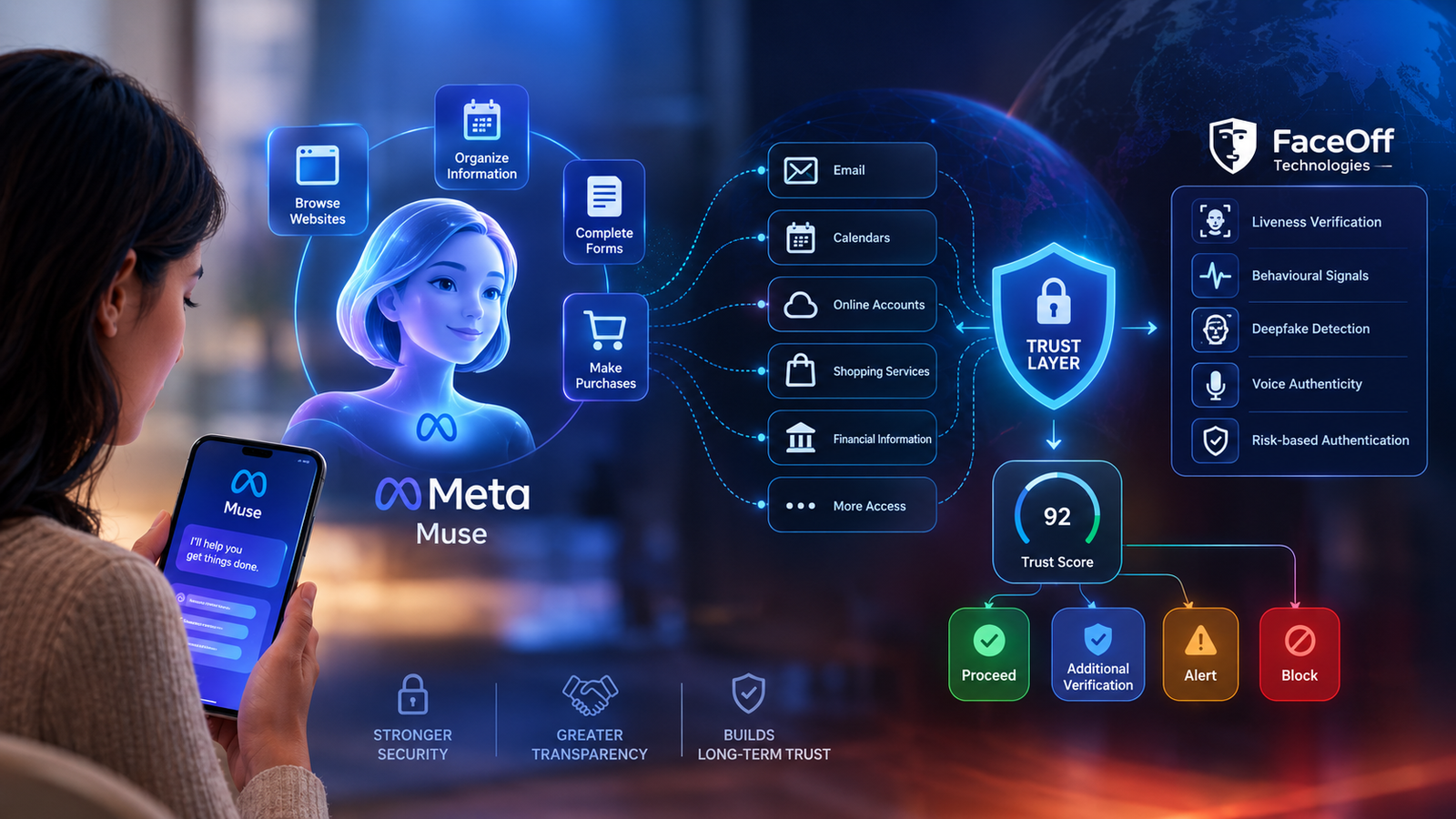
Meta’s new personal AI agent Muse represents an important transition from conversational AI to action-oriented AI. Instead of merely answering questions, Muse can browse websites, organize information, complete forms and assist with purchases bringing AI closer to becoming a digital assistant that acts for users.
Its strong early consumer response demonstrates growing interest in agentic AI. But the more tasks an AI agent performs, the greater the level of access and trust users must provide. Connecting email, calendars, online accounts, shopping services and potentially financial information creates a significantly larger digital trust surface.
This changes the cybersecurity equation. Traditional applications wait for users to perform actions; AI agents can potentially execute multiple actions across interconnected platforms. Strong authentication, permission management, credential protection and continuous verification therefore become critical.
The reported decision by Amazon to restrict Muse also highlights another emerging issue: user authorization does not automatically mean platform authorization. Websites will increasingly need mechanisms to distinguish legitimate AI agents from bots, fraudsters and automated attacks.
For Meta, long-term adoption will consequently depend on more than AI intelligence. Users need transparency over what Muse can access, what actions it performs, why decisions are made and how permissions can be withdrawn.
The next phase of agentic AI will therefore be built around a new principle: Trust before Action. Every sensitive action should be authenticated, authorized, contextualized and auditable.
FaceOff Technologies Could Enhance Trust
FaceOff Technologies could potentially add a continuous trust layer around Meta/Facebook interactions by combining liveness verification, behavioural signals, deepfake and synthetic-media detection, voice authenticity and risk-based authentication. A Trust Factor and Confidence Score could help determine whether an interaction should proceed, require additional verification, trigger an alert or be blocked.
FaceOff Technologies could create a continuous trust framework that verifies user identity, analyzes behaviour and liveness, detects synthetic or manipulated media, generates a real-time Trust Score, and uses that intelligence to determine whether a Meta or Muse interaction should proceed, require additional verification, trigger an alert, or be blocked.
Such integration would require Meta’s technical approval, appropriate APIs, user consent, privacy safeguards and formal collaboration; it should therefore be viewed as a potential architecture rather than an existing Meta–FaceOff integration.