
Post-Quantum Cryptography Moves from Research to Real-World Security
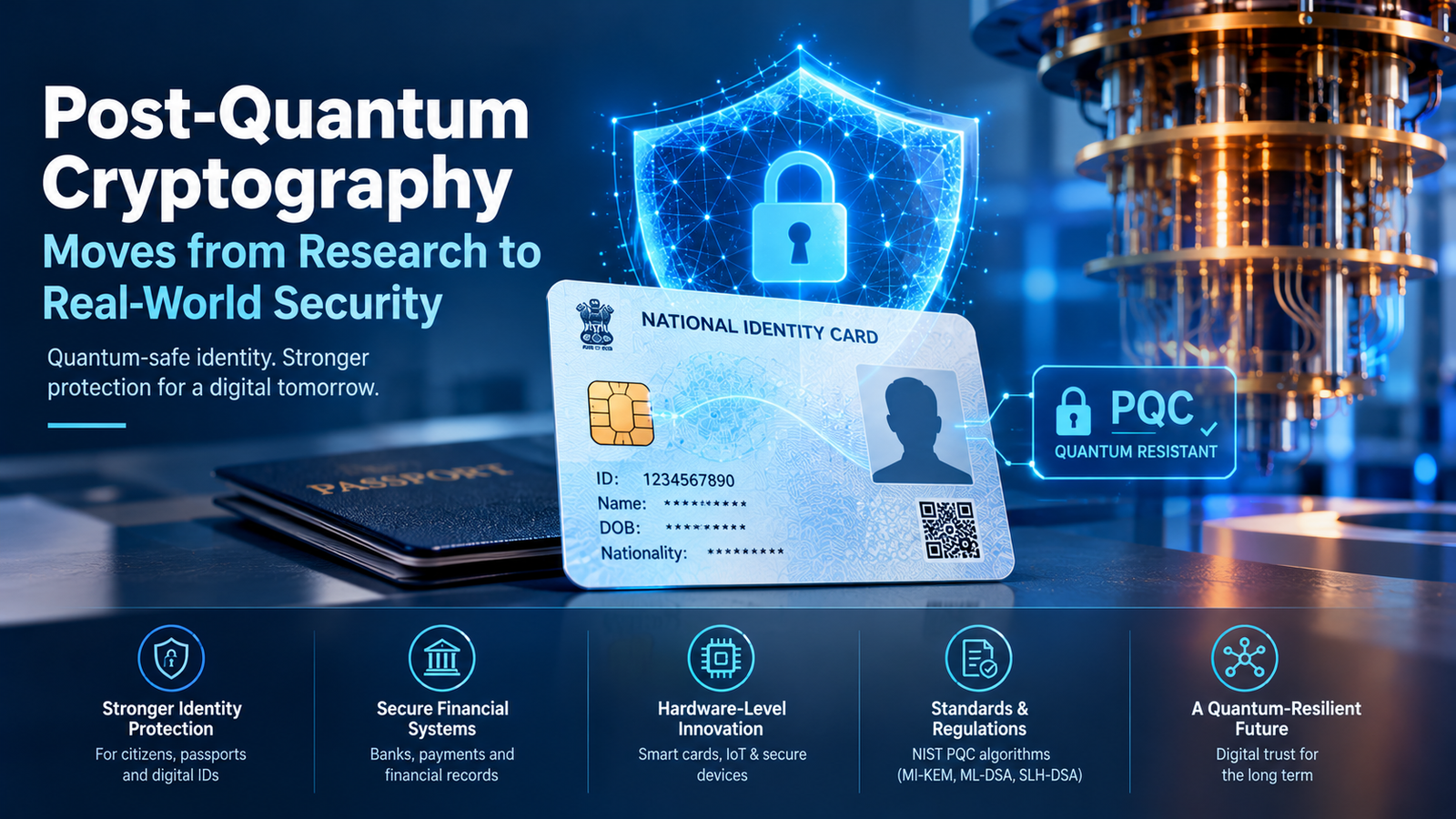
The development of a quantum-safe national identity card marks a turning point for the cybersecurity industry. It shows that Post-Quantum Cryptography (PQC) is moving beyond theoretical research into practical implementation.
A recent industry award for Post-Quantum Cryptography Excellence, presented to a consortium of security technology firms and a national identity document producer, highlights an important breakthrough: quantum-resistant cryptographic algorithms can run even on resource-constrained identity card chips.
Why this development matters
Until recently, a major barrier to PQC adoption was doubt over whether quantum-resistant algorithms could run efficiently on devices with limited memory, processing power and energy.
The demonstrator addresses this with a hybrid architecture that combines conventional cryptography with post-quantum algorithms. Specialised security chips enable an efficient implementation while also protecting against side-channel attacks.
This matters because national identity cards, passports, banking cards, SIMs and other secure credentials often stay in circulation for years. Their cryptographic protection must remain dependable well into the future.
Key drivers accelerating PQC adoption
- Harvest now, decrypt later: attackers may collect encrypted data today and try to decrypt it once sufficiently capable quantum computers exist.
- Digital identity protection: governments must protect national identity systems, electronic passports, digital signatures and citizen authentication against future cryptographic threats.
- Banking and financial security: banks, payment networks and financial institutions will need quantum-resistant protection for sensitive communications, digital certificates and long-lived financial records.
- Hardware-level innovation: running PQC on constrained chips opens opportunities for smart cards, secure elements, IoT devices and embedded authentication systems.
- Regulatory and standards adoption: NIST's standardisation of algorithms such as ML-KEM, ML-DSA and SLH-DSA gives enterprises a foundation for migration planning and technology development.
The next growth opportunity for the industry
The commercial opportunity goes far beyond swapping encryption algorithms. PQC will create demand across cryptographic discovery, certificate management, hardware security modules, identity platforms, secure firmware, network infrastructure, cloud security and cryptographic lifecycle management.
Technology vendors, system integrators and cybersecurity partners will increasingly need to help customers find vulnerable cryptographic dependencies, set migration priorities and deploy crypto-agile systems that can absorb future algorithm changes.
For India, the opportunity is especially large because of the scale of its digital public infrastructure, Aadhaar-linked identity ecosystem, banking platforms, telecommunications and government services.
However, PQC adoption will require careful compatibility testing, performance benchmarking, interoperability planning and phased migration. A successful demonstrator proves technical feasibility; it does not mean every existing identity system is ready for nationwide deployment.
The strategic significance
The next major cybersecurity transformation will be the shift from quantum-vulnerable infrastructure to quantum-resilient digital trust.
This demonstrator shows that the transition can begin at the hardware identity layer, rather than staying confined to high-performance servers and data centres.
The industry should stop asking when quantum computers will break today's cryptography and start asking how quickly organisations can identify, prioritise and modernise the cryptographic systems they rely on.
PQC is becoming a long-term infrastructure requirement. Organisations that begin migration planning early will be better prepared to protect sensitive information, digital identities and critical services in the quantum era.