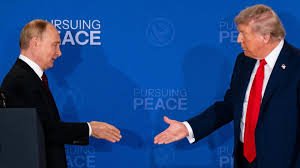
Anchorage, Alaska | August 15, 2025 — Russian President Vladimir Putin and U.S. President Donald Trump appeared together at Joint Base Elmendorf-Richardson after a high-stakes meeting on ending the war in Ukraine. The symbolic choice of U.S. soil underscored the significance both leaders attached to the summit.
Putin described the talks as “constructive and trust-based,” voicing satisfaction with Trump’s readiness to re-engage in direct diplomacy. He framed the Ukraine war as a “tragedy” stemming from unresolved European security disputes and praised Trump’s willingness to consider what Moscow calls the conflict’s root causes.
Central to Putin’s remarks was a renewed push for a broader European security framework that halts NATO’s eastward expansion and recognizes Russia’s strategic interests. He also highlighted opportunities for cooperation in trade, energy, technology, and Arctic projects, suggesting pragmatic ties could benefit both nations.
Trump, for his part, struck a conciliatory tone. He emphasized his personal rapport with Putin and hinted that progress could come through continued engagement. However, he avoided criticizing Russia’s territorial claims in Ukraine—marking a softer stance than previous U.S. administrations.
Despite the display of unity, the summit delivered no ceasefire, peace framework, or binding commitments. Analysts widely viewed the event as a public relations victory for Putin, reinforcing his image as a statesman open to peace but on Russia’s terms.
Observers noted that Trump’s position appeared more aligned with Moscow’s demands, raising concerns that Kyiv’s bargaining power could be undermined. This shift was interpreted as a strategic win for Russia.
Ultimately, the Anchorage summit was less about resolving the war than about reframing the diplomatic narrative. While Putin projected openness to dialogue, his fundamental objectives—security guarantees, NATO rollback, and recognition of territorial outcomes—remained unchanged.